The Technical Audit: Why Vaibhav Sooryavanshi’s Bat-Swing Faces a Structural Test in Manchester
A Rajasthan Royals teammate casts doubt on Vaibhav Sooryavanshi's style ahead of the Manchester T20I. Inside the technical analysis of his bat-swing.
Loading...

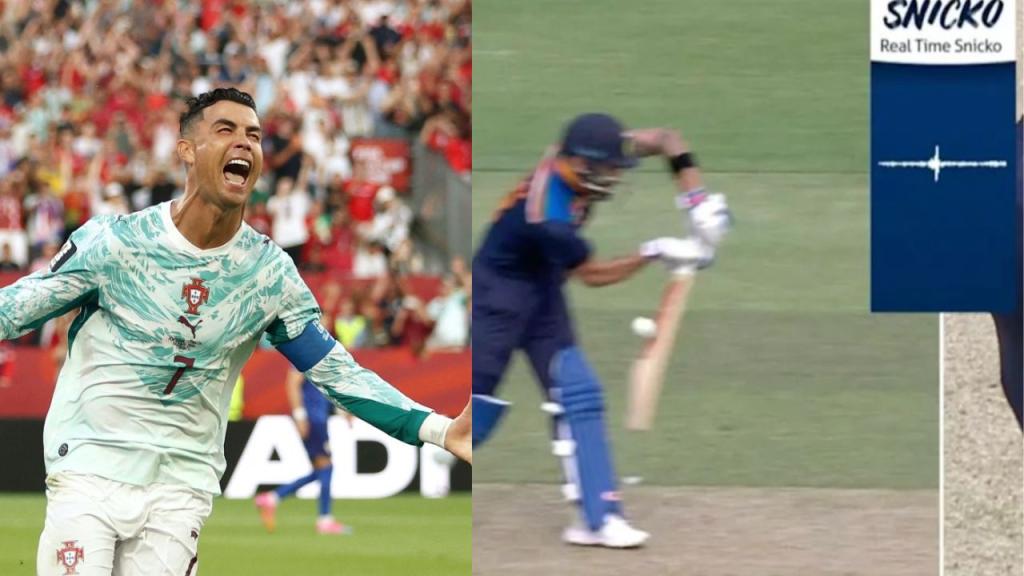
Inside the VAR chaos: Learn how cricket's Snicko technology tracked a micro-touch to save Cristiano Ronaldo and Portugal at the 2026 World Cup.
I stood by the sightscreen at the Himachal Pradesh Cricket Association Stadium in Dharamshala during the tense final overs of a recent IPL match, watching an elite paceman execute a perfect slower-ball bouncer in the 19th over. The batter swung, the ball zipped past the toe of the bat, and the on-field umpire signaled a wide. Instantly, the bowling captain triggered a review. Within thirty seconds, the giant screen displayed UltraEdge—cricket’s trusted Snickometer—showing a distinct, sharp spike precisely as the leather passed the wood. It was a routine example of cricket's technical precision. Yet, hours later on July 3, 2026, that exact technology crossed sporting borders in Toronto, tracking an invisible micro-touch to disallow a 103rd-minute Croatian equalizer, preserving Cristiano Ronaldo’s final international run in a chaotic FIFA World Cup Round of 32 clash.
Table of contents [Show]
The technology that broke Croatian hearts and extended Cristiano Ronaldo's campaign relies on the same acoustic and inertial physics used to police the corridor of uncertainty in elite cricket. While cricket uses highly sensitive stump microphones to capture the audio frequency of an edge, modern football utilizes a microchip suspended inside the center of the ball.
The official tournament ball, the Adidas Trionda, features a highly advanced Inertial Measurement Unit (IMU) sensor. This sensor operates at a frequency that transmits packet data 500 times per second to the Video Assistant Referee (VAR) hub. When Croatian forward Igor Matanovic rose to challenge a late cross, visual broadcast angles were entirely inconclusive. To the naked eye, the ball seemed to sail cleanly over his head before deflecting off a defender and landing at the feet of an attacker.
This is where the cricket blueprint becomes relevant. Just as a bowler hitting a hard-length with a cross-seam grip expects the technology to pick up a faint glove-touch on a heavy-ball, the IMU sensor inside the football tracked a minute soundwave and pressure spike. The data manifested on the VAR monitors as a classic "heartbeat" graphic—the exact visual twin of cricket’s Snicko. The microchip registered that the ball had grazed Matanovic’s hair. Because a teammate was standing past the defensive line at the exact fraction of a second that spike occurred, the system generated an irrefutable offside baseline.
The implementation of tracking data in the 2026 World Cup proves that micro-metrics are reshaping competitive strategy. Many pundits argue that a ball grazing a player's hair should not dictate the outcome of an elimination match. However, sports science ignores sentiment.
The Line of Deviation: Much like a batsman getting undone by a 1.8-degree seam movement on a tacky pitch, defenders rely on absolute predictability. The tiny flick altered the ball's velocity just enough to beat the covering defender, Renato Veiga.
The Powerplay Equivalent: In modern sport, early and late-phase exploitation requires absolute spatial control. Portugal boss Roberto Martinez had built a low-block defensive system to protect a fragile 2-1 lead after Cristiano Ronaldo scored his first-ever World Cup knockout goal from the penalty spot in the 68th minute.
The Structural Vacuum: When the goal was initially given, Portugal's defensive structure collapsed into frantic arguments. The intervention of the acoustic spike restored order, illustrating that hyper-precise data is now the ultimate arbitrator of athletic justice.
The structural metrics of Cristiano Ronaldo’s performance on July 3, 2026, highlight how minimal margins dictate maximum output in the modern era.
| Player / Element | 2026 Tournament Metric | Primary Tracking System | Tactical Outcome |
|---|---|---|---|
| Cristiano Ronaldo | 1 Knockout Goal (81 Mins) | Semi-Automated IMU | Maintained Active Campaign |
| Igor Matanović | 1 Micro-Touch Registered | Connected Ball Sensor ("Snicko") | Triggered Offside Decision |
| Josko Gvardiol | 103rd-Minute Strike Disallowed | Combined VAR Optical Tracking | Goal Overturned |
| Elite IPL Pacer | 58% Dot-Ball Average | Ball-Tracking & UltraEdge | Validated Review System |
This isn't a fluke of refereeing; it's a technical glitch in the traditional way football fans view the game. The cross-pollination of cricket's review philosophy into global football proves that high-specification data will continue to rule over human perception. Cristiano Ronaldo and Portugal survived because the technology managed to isolate a microscopic impact that no human eye could verify from a broadcast angle. As the 2026 World Cup moves into the Round of 16, this incident sets an immutable precedent. Whether it is a batsman protecting his off-stump or a legendary forward protecting his international legacy, the acoustic spike remains the final, cold line of defense against human error.

A Rajasthan Royals teammate casts doubt on Vaibhav Sooryavanshi's style ahead of the Manchester T20I. Inside the technical analysis of his bat-swing.
Finland faces Portugal in the 1st T20I of the 2026 series at Kerava. Technical analysis of pitch friction, team squads, and expert match predictions.
Pakistan head coach Mike Hesson exposes the technical and mental flaws holding the team back against India. Inside the tactical blueprint for the 2027 World Cup.